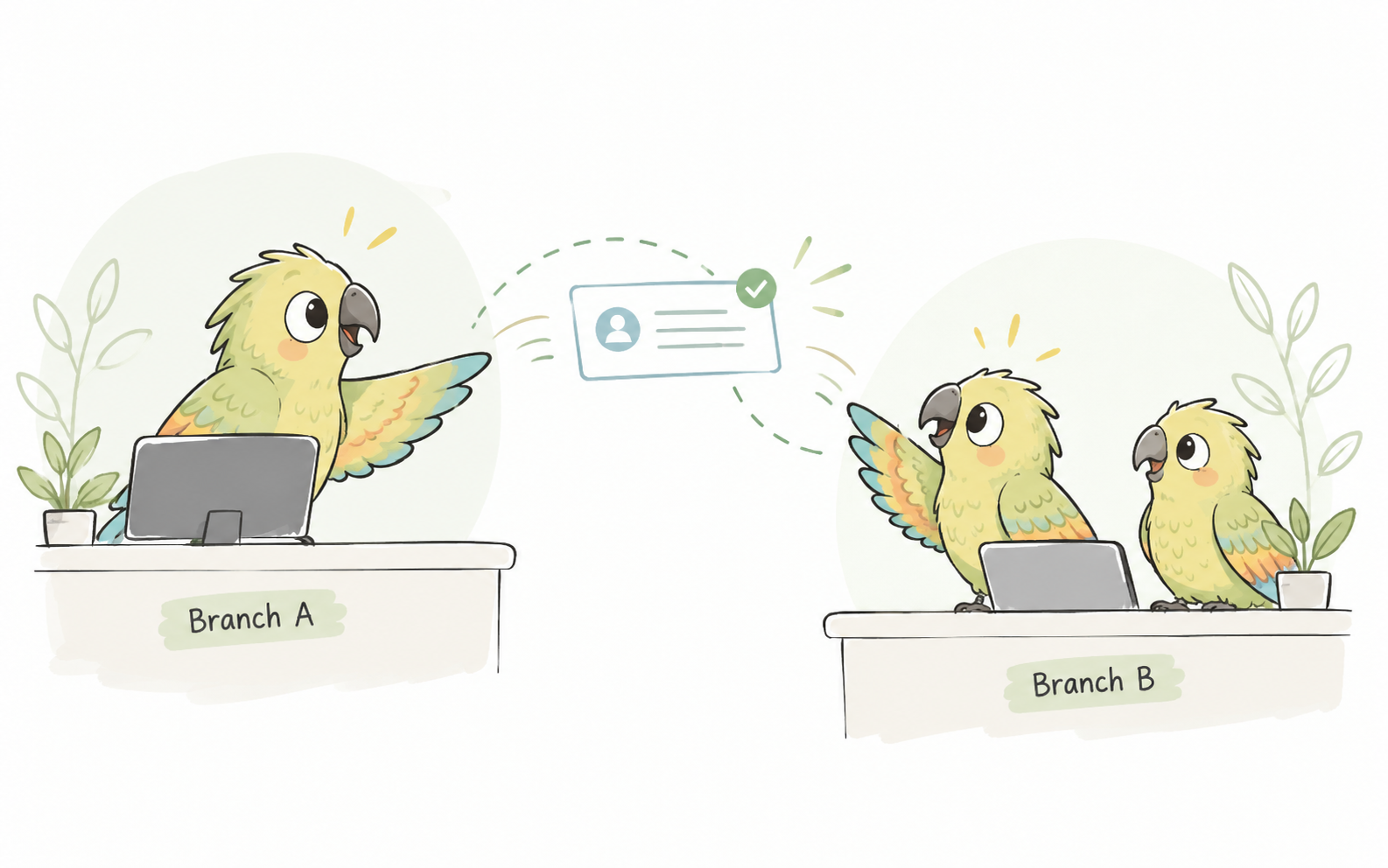
Put every customer message in one shared place, give each conversation one clear owner, and make it easy to pass a conversation to another branch without retyping it. Messages get lost when they sit in separate inboxes and personal phones. Fix where they live first, then fix who owns them.
The rest of this post covers why messages go missing, five habits that stop it, what to do when a message lands at the wrong branch, and how to check that it is working.
A quick note on evidence. There is very little published research on how multi-branch businesses hand over customer messages. So most of this post is our experience and opinion, and we label it that way. Where we have a source, we link it.
Why do customer messages get lost between branches?
In our experience, it is rarely one big mistake. It is a handful of small gaps that add up
- The message goes to the wrong branch. A customer replies to a reminder, but the job is at a different location.
- The message sits somewhere private. A personal phone, a single person's inbox or a note on a desk.
- Nobody knows who has it. Two people reply and give different answers, or nobody replies because everyone thinks someone else did.
- People are away. Someone is off sick, on leave or busy on the workshop floor.
- One customer, two channels. They send a text and then an email about the same job, and the two never meet.
None of these is about effort. They are about where messages live and whether anyone can see them.
What does a lost message actually cost?
A customer who asks a question and hears nothing usually does one of two things. They book somewhere else, or they forget about the job altogether.
There is some research on speed. A 2011 Harvard Business Review article, "The Short Life of Online Sales Leads" by James Oldroyd, Kristina McElheran and David Elkington, found that most companies are not responding nearly fast enough to online sales leads. That study looked at sales enquiries, not service businesses, so treat it as a signal and not a promise about your branches. https://hbr.org/2011/03/the-short-life-of-online-sales-leads
The cost we see most often is quieter. It is a customer who was ready to book, waited, and quietly lost interest. You never find out, because they never complain.
How do you stop messages getting lost? Five habits
1. Keep every message in one shared place
All replies from all branches should land in the same list that every branch can see. If a message can sit on one person's phone, it will eventually get stuck there.
2. Keep one thread per customer
A text and an email from the same person about the same job should be one conversation, with their contact details and booking attached. That way nobody has to hunt for the earlier message or ask the customer to repeat themselves.
3. Give every conversation one owner
At any moment, one person or one branch should be responsible for the next reply. Everyone else can see the thread, but only the owner answers it. This stops the double reply and the silent gap.
4. Make handing over simple
If a message belongs to another branch, passing it on should take one step, and the whole conversation should travel with it. No copying, no forwarding and no retyping.
5. Agree on a reply target
Pick a time you expect every branch to meet and write it down. There is no official standard, so this is our opinion. A sensible starting point is a quick acknowledgement within the same working day, even if the full answer takes longer.
What should you do when a message lands at the wrong branch?
Do not tell the customer to ring another number. That sends the work back to them.
Instead:
- Read the message and work out which branch should have it. Usually it is the branch where the job will be done.
- Transfer the whole thread to that branch. Add a short note so they do not need to ask again.
- Tell the customer once who will pick it up. One short line is enough.
- Let the new owner reply. The first branch is done.
Here is an example of a good handover note. The branches are made up.
Transferred to Lower Hutt. Customer asked about a Saturday inspection for two vans. Booking request is attached.
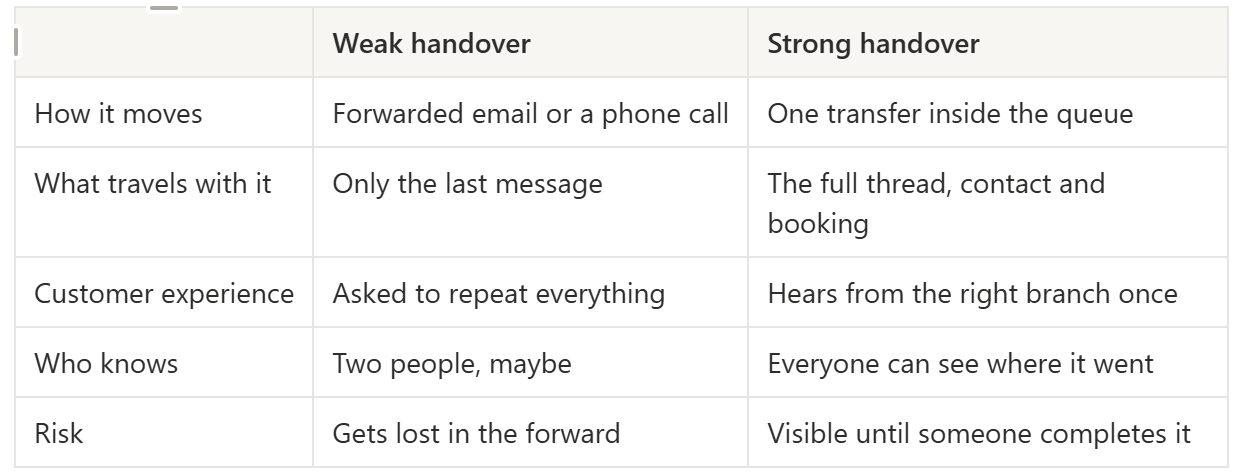
Here is how a weak handover compares with a strong one.
Who should own a customer conversation?
This is our opinion, not a rule. We would say the branch that will do the job owns the conversation. If there is no booking yet, the branch the customer asked about owns it.
Whatever rule you choose, keep two things true:
- Ownership stays put until someone changes it. A thread should not drift.
- Ownership is written down. Everyone should be able to say who owns a message without asking around.
What about unsubscribe requests across branches?
This one is easy to miss. In New Zealand, the Department of Internal Affairs says an unsubscribe request must be honoured, and it treats still sending messages five working days after someone unsubscribes as a problem. https://www.dia.govt.nz/Information-about-unsubscribing
For a business with several branches, that means a customer who opts out with one branch should stop hearing from all of them. If each branch keeps its own list, that is easy to get wrong. A single suppression list at account level is much safer.
This is general information, not legal advice. If you are unsure, check with DIA or a lawyer.
How can you tell if messages are still getting lost?
You do not need a complicated report. Check three things each week:
- How old is your oldest open conversation? If something has been waiting for days, find out why.
- How many conversations have no clear owner? The answer should be zero.
- How many transferred conversations are still unanswered? These are the ones most likely to slip.
Then ask a few customers how it felt to get in touch. They will tell you things your numbers do not.
Do you need special software to manage this?
Not at the start. Two branches with a shared inbox and a clear rule can manage for a while. The trouble tends to show up later, when volume grows, when a third branch opens, or when people start asking "did anyone reply to that?"
That is what we built Fridgedoor for. Every reply from a customer lands in one queue that all your branches share. Each conversation is a thread that carries the contact and the booking. Whoever is on shift can see what has been answered and what is still waiting, and they can mark a thread complete, transfer it to another branch or reply from the same screen. Each branch keeps its own opening hours and booking preferences, and the account keeps roles and an activity trail on every enquiry. Here is how it works step by step.
We also wrote about why reply speed and plain language matter more than the tool you use, in our post on customer communication. And if your messages start as service reminders, our post on how to send service reminders that get bookingscovers what happens before the reply.
Frequently asked questions
What is the difference between a shared inbox and a shared queue?
This is our view. A shared inbox is one mailbox that several people can open. A shared queue adds status and ownership on top, so you can see whether a message is open, waiting for the customer or finished, and who is responsible for it. For one location a shared inbox is often enough. For several branches, the ownership part matters more.
How fast should a branch reply to a customer?
There is no official standard. Our suggestion is a quick acknowledgement the same working day, and a full answer as soon as the owner can give one. Whatever you choose, write it down so every branch works to the same target.
What if two people reply to the same customer?
It usually means the thread had no clear owner. Give every conversation one owner, and make the thread visible to everyone else so they know to leave it alone. If it still happens, treat it as a process gap and not a person problem.
Should each branch have its own sender name or number?
Customers recognise the branch they visit, so we think using the branch name in the message helps. Behind the scenes, though, replies should still land in one shared place. That gives the customer a familiar name and gives your team one list.
Can customers contact a different branch than the one that sent the reminder?
Yes, and it happens often. That is exactly why a transfer step matters. The customer should never have to repeat themselves because they replied to the wrong location.
 Fridgedoor