 Fridgedoor
· Katz
Social Media for Car Dealers: What to Post and Why
Social media helps car dealers and service centres get found, build trust and win bookings. What to post, and why replying fast matters.
· Katz
Social media helps car dealers and service centres get found, build trust and win bookings. What to post, and why replying fast matters.
Social media for car dealers is important. Car dealers have plenty of opportunities to leverage social media beyond simply sharing vehicle photos, think of it as a powerful tool for driving sales, building customer confidence, keeping loyal buyers coming back, and it gets a fast, human reply when someone gets in touch. Without those pieces, posting becomes nothing more than meaningless chatter.
Vehicle dealership owners, sales team managers and service department managers at car dealerships and vehicle service centres, including those operating multiple locations.
Because buyers do research and gather information before they contact you and most of that happens on their phones. Social media helps a dealership become visible during that research stage and gives potential customers a sense of the people, cars, service and reputation behind the business. Building that relationship with customers is therefore crucial.
Today, car buyers don't rely solely on visiting dealerships to decide what to buy. Cox Automotive's 2025 Car Buyer Journey [https://www.coxautoinc.com/wp-content/uploads/2026/01/2025-Cox-Automotive-Car-Buyer-Journey-Study-Summary.pdf] Study found that buyers visited an average of 4.6 websites during their shopping journey. 75% visited third-party automotive websites, 59% visited dealership websites and 26% used social media.
This matters for dealerships because customers are already looking for information online before and during the buying process. Social media gives dealers another opportunity to be visible, build familiarity and showcase their vehicles when potential buyers are researching their options
Social media isn't necessarily where every buyer starts, but it is one of the places buyers use during the car-buying journey.
Social networking is crucial for car dealers for a number of reasons. Social media can be incredibly beneficial, from being found to maintaining the dealership's reputation.
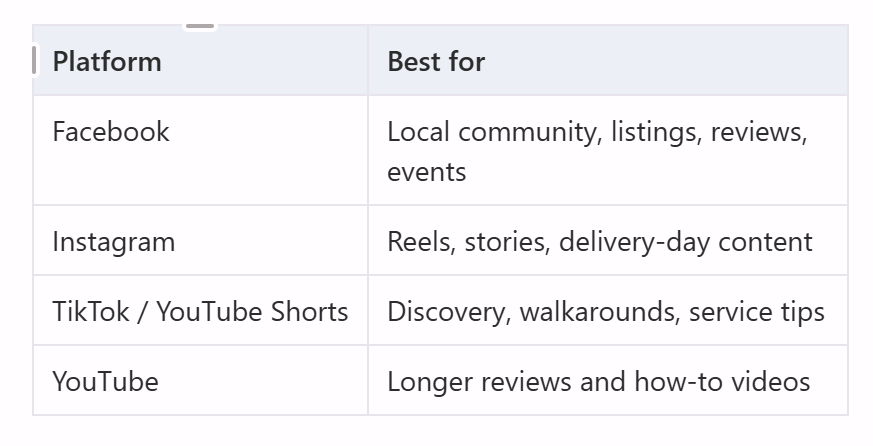
People use Facebook, Instagram, TikTok and YouTube to find cars, dealerships, features and other special deals.
A website listing states only the facts and specifications where as social media lets a dealer show the car itself through :
Customers can see the dealership’s staff, facilities, customer deliveries, reviews, expertise and various daily operations before they ever walk-in, creating a sense of familiarity during their initial visit instead of it feeling impersonal.
Every post has the potential to be turned into a query like a DM, a phone call, a website visit, a test-drive booking, a finance query, or a trade-in query, each of which is a lead that wasn't derived from a straightforward listing.
Someone may not be researching for a specific car today, but a short video of an interesting vehicle can prompt the thought: "In reality, I could use something similar to that." This represents demand that social media actively generates, rather than merely capturing existing demand.
Car buying often has a long gap between first interest and purchase, sometimes three months or even longer. Sharing helpful, relevant content on a regular basis helps your dealership stay fresh in customers' minds, so you're the first place they think of when they're prepared to buy.
Cars are easy to compare on spec and price but, people are harder to compare. Showing your team members and their unique personalities helps create a welcoming atmosphere that makes customers feel comfortable visiting your dealership.
Building a strong social strategy is the first step as a good one would have several content types rather than simple posting “ 2020 Toyota Corolla, $20,000. Call us.”
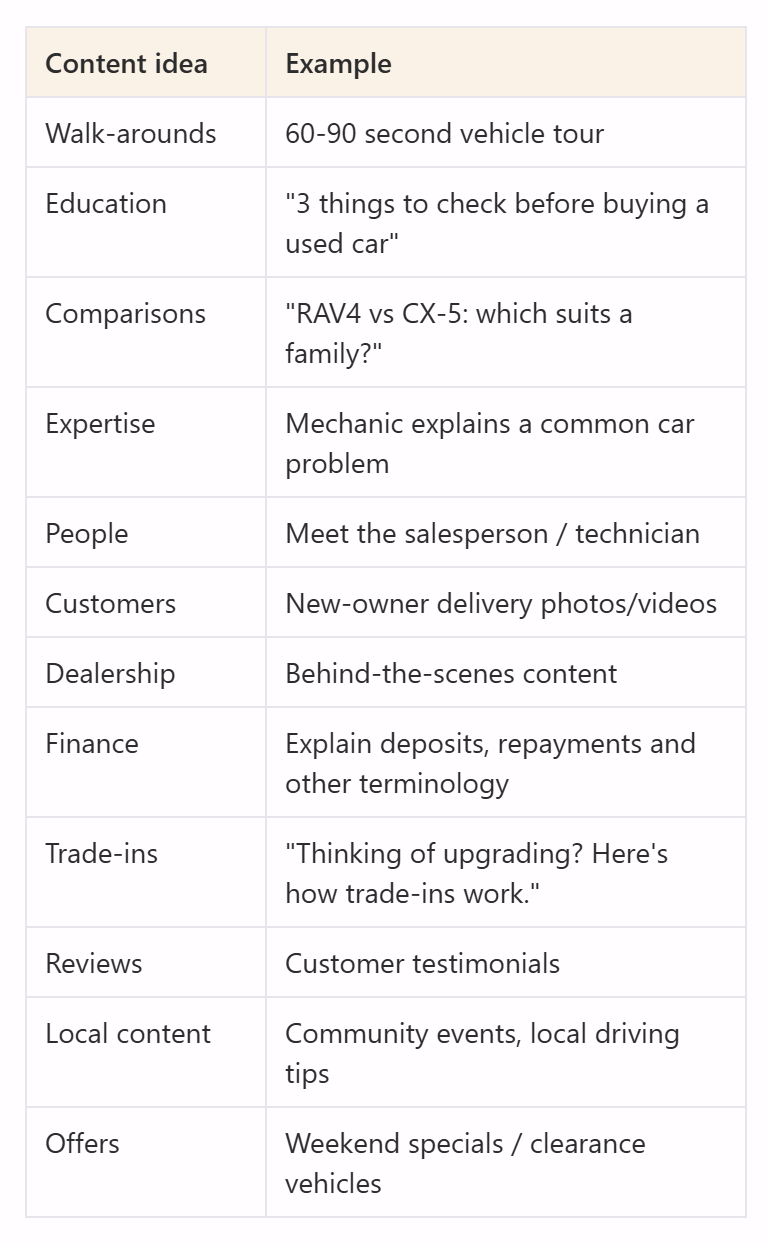
Short, honest videos of real cars, filmed on a phone, by someone who knows the car.
Cars are physical, visual purchases. People want to see the paint in daylight, hear the engine and check the boot before they drive across town.
Fact. CDK Global reports that dealers who utilize video in the sales process not only see 81% in lead-to-contact rate but they also sell twice as many cars. [https://www.cdkglobal.com/insights/turn-sales-teams-video-stars]
Yes. A dealership sells a car once every few years. A service centre can see that customer several times a year.
Useful, specific tips keep you visible between services. Tips matched to the customer's own car get saved and shared far more than generic advice.
Yes. Posting gets attention. Replying promptly is what turns it into a booking.
A comment like "Do you do inspections on Saturdays?" is an enquiry. If it waits two days, that customer has usually gone elsewhere.
Our suggested check for any dealer or service centre.
Consistency beats volume. A realistic start is three to five posts a week on two or three platforms.
Track outcomes, not likes.
Review these monthly. Keep what works and drop what does not.
Social media gets the first conversation. The rest of the customer relationship runs on reminders, bookings and replies, and that is where many multi-branch businesses lose track.
fridgedoor is a shared queue for those. A service reminder goes out by text or email, the customer confirms or picks another time on their phone, and the reply lands in one queue your branches share. There is nothing to install for your customers.
If you run more than one branch and want to see how it would fit, you can register your interest or read how it works. If it is not a fit, we will say so.
Yes. Small and independent dealers often gain the most, because local trust matters. A simple feed of honest videos and quick replies is enough to start.
Video shows sound, space and how features work, which photos cannot. Use photos for listings and video for building confidence.
Yes, when they are minor and real. It builds trust and avoids surprises at inspection.
Mainly they build loyalty and visibility with local car owners, which supports repeat service and referrals. Track bookings that begin on social media to see what it does for you.
Talk to us
Tell us your branches, your channels, and roughly how many customers come due each month. If it is not a fit, we will say so.
One business dayOne person, one email. No sequence, no drip, and no calendar link to negotiate with.